How Licensing Works in Modern Online Games
Most online games operate under a traditional licensing model where players purchase access to software but do not actually own the underlying digital content. Game publishers retain full control over servers, characters, in-game items, and virtual currencies, while users receive a limited license to interact with the game world.
Phantom Galaxies approaches this system differently by combining conventional game licensing with blockchain-based digital ownership. The game itself remains licensed software developed by Blowfish Studios and supported by Animoca Brands, but certain in-game assets exist independently as NFTs that players can genuinely own.
This hybrid structure became one of the defining ideas behind Phantom Galaxies from the project’s earliest announcements. Official statements described the game as a blockchain-powered action RPG where players could obtain “true ownership and control” of specific digital assets connected to the game universe. :contentReference[oaicite:0]{index=0}
Instead of replacing traditional licensing entirely, Phantom Galaxies separates gameplay access from ownership of blockchain assets. Players still access the game through standard software distribution platforms such as Steam, Epic Games Store, HyperPlay, and Ultra Games, while NFTs and blockchain mechanics operate alongside the core experience. :contentReference[oaicite:1]{index=1}
This approach allows Phantom Galaxies to appeal to both traditional gamers and Web3 users. Players who prefer standard gameplay can simply install and play the game, while blockchain-focused users can connect wallets and interact with NFT systems tied to planets, starfighters, avatars, and collectibles.
The Difference Between Licensed Content and NFT Ownership
Understanding the distinction between licensed gameplay and owned blockchain assets is essential to understanding Phantom Galaxies itself. The game client, servers, narrative systems, and core gameplay mechanics remain intellectual property controlled by the developers. Access to those systems is governed by traditional licensing agreements similar to most online multiplayer games.
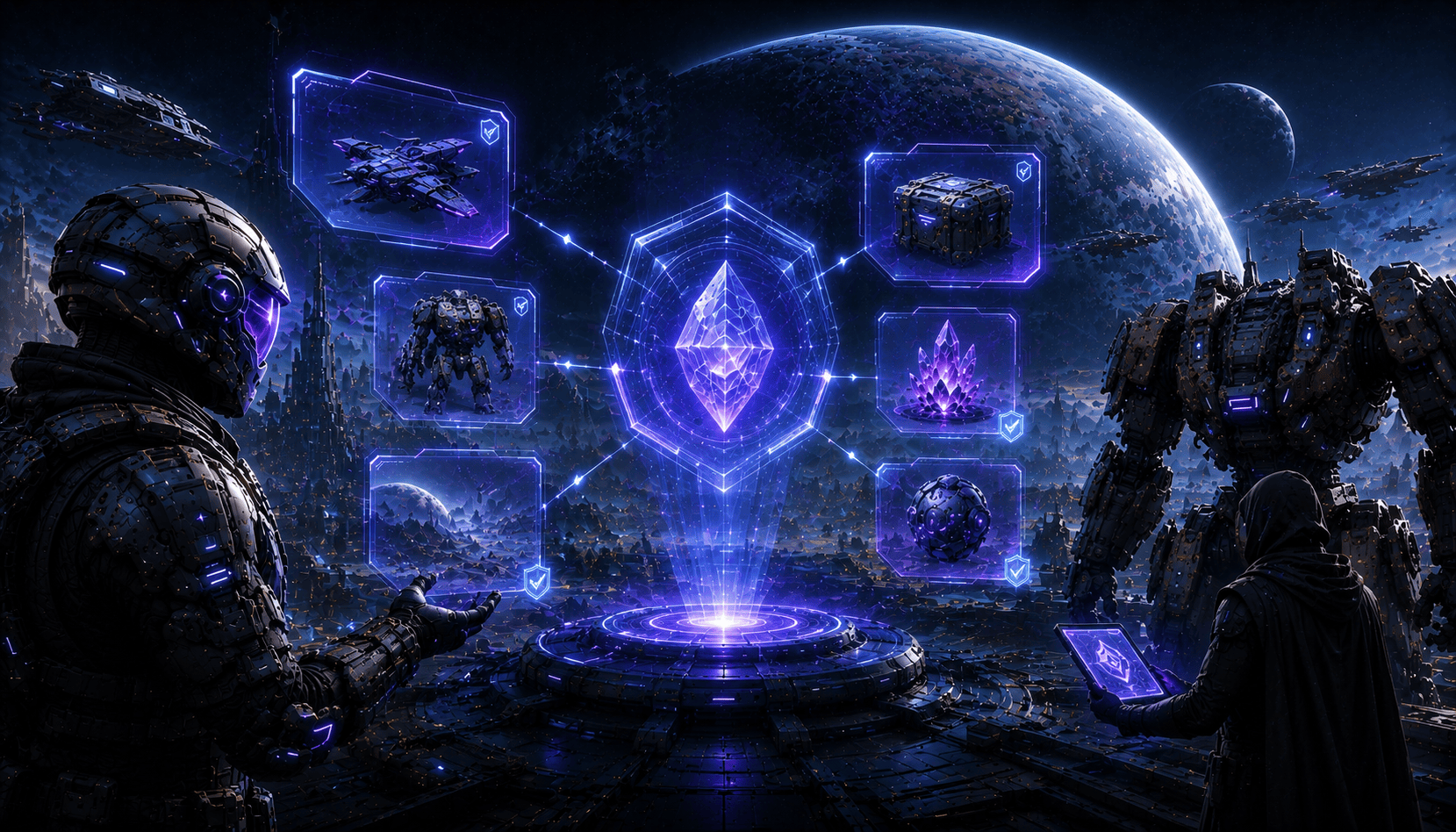
However, NFTs connected to Phantom Galaxies operate differently. Blockchain assets such as Planet Genesis NFTs, Origin Collection Posters, Avatars, and Starfighters are stored on decentralized networks and linked directly to player wallets rather than publisher-controlled databases.
Official project descriptions repeatedly emphasize that these assets are designed to provide players with verifiable ownership rights. :contentReference[oaicite:2]{index=2}
Several important distinctions define the system:
- The game software itself remains licensed property
- NFTs exist independently on the blockchain
- Players control NFT assets through private wallets
- Blockchain ownership can extend beyond the game client
- Traditional gameplay remains accessible without NFTs
This structure gives Phantom Galaxies more flexibility than many earlier blockchain games. Instead of forcing every user into Web3 systems immediately, the game allows gradual participation depending on player interest.
The Epic Games Store description for Phantom Galaxies also notes that blockchain transactions and digital asset activity are handled directly by the publisher rather than the storefront itself. :contentReference[oaicite:3]{index=3}
That distinction is important because ownership of NFTs does not automatically grant ownership of the Phantom Galaxies intellectual property or software platform. Players own the blockchain assets associated with their wallets, but the broader game universe remains protected under standard copyright and licensing laws.
This balance between centralized game development and decentralized ownership represents one of the major experiments happening within modern Web3 gaming.
How Blockchain Changed Digital Ownership
Before blockchain gaming emerged, virtual ownership in online games was mostly limited to platform-controlled databases. Players could spend years collecting items or building characters, but those assets technically remained under publisher control.
Phantom Galaxies introduced blockchain integration to create a different relationship between players and digital assets. NFTs tied to the ecosystem can potentially be traded, transferred, or stored independently of the game client itself.
Several Phantom Galaxies systems rely heavily on this ownership model:
- Planet Genesis NFT ownership
- Origin Collection Posters and Episode Medals
- Avatar NFTs with unique traits
- Starfighter NFTs tied to gameplay systems
- ASTRAFER-related ecosystem rewards
The project’s vision goes beyond simple collectibles. Developers have repeatedly described plans for planets, governance systems, player-driven economies, and infrastructure mechanics connected directly to NFT ownership. :contentReference[oaicite:4]{index=4}
This philosophy became especially visible during events such as Astrafite Rush, where NFT ownership influenced ASTRAFER reward systems and ecosystem participation. Community activities, progression mechanics, and ownership structures increasingly became interconnected inside the Phantom Galaxies universe. :contentReference[oaicite:5]{index=5}
The combination of licensing and ownership also helps Phantom Galaxies avoid some problems experienced by earlier NFT projects. Because the game still operates as a traditional online action RPG at its core, blockchain systems function as enhancements rather than replacements for gameplay.
Players who never connect wallets can still participate in combat missions, exploration, multiplayer activities, and story progression. Meanwhile, users interested in Web3 systems gain access to deeper economic and ownership mechanics.
The Future of Licensing in Web3 Gaming
Phantom Galaxies represents a broader transition happening across the gaming industry as developers explore new forms of digital ownership. Traditional game licenses are unlikely to disappear entirely, especially in large multiplayer environments requiring centralized development and server infrastructure.
However, blockchain technology introduces new possibilities where players can own certain parts of the ecosystem independently. Phantom Galaxies attempts to combine both systems into a single experience where gameplay remains accessible while ownership becomes more meaningful.
This hybrid model may become increasingly common in future online games. Instead of replacing publishers entirely, blockchain systems may expand player participation within established gaming structures.
Community interest in Phantom Galaxies continues to focus heavily on how ownership systems will evolve over time. Planet governance, marketplace functionality, guild infrastructure, and ASTRAFER integration are all expected to deepen the relationship between players and the digital universe they inhabit.
At the same time, licensing protections remain necessary to preserve the game’s intellectual property, maintain server stability, and support long-term development. Phantom Galaxies therefore exists at the intersection of two worlds: traditional game publishing and decentralized digital ownership.
As Web3 gaming technology matures, Phantom Galaxies may serve as one of the early examples of how licensing and blockchain ownership can coexist inside a large-scale multiplayer sci-fi universe.